bambuVault
In useFive drawers in this house are organised by a program, and a sixth is on the printer. bambuVault takes a drawer's measurements, works out how a 42 mm grid fits inside it, and generates what it takes to make the grid fit that drawer — the baseplate tiles, the bins, the lids, the lift-out trays, and the wedges that take up the slack. There is no interface, because the drawer is the interface.
Figures measured 2026-07-14.
What it does
a compiler whose output you can holdIt does the arithmetic you would get wrong. A drawer gets measured in inches, with a tape, by hand. Gridfinity is a 42 mm grid. The script converts one to the other and works out how many whole cells actually fit — always rounding down, because a grid that overhangs the drawer is a grid that does not go in. What is left over is a rim of stray millimetres around the edge, and that rim is the entire problem: an unanchored baseplate slides every time the drawer is opened. So the script sizes filler pieces to exactly the leftover and wedges the grid still.
It generates the parts — all of them. Seven kinds: the baseplate tiles that the grid clips into, the bins, drop-on lids, lift-out trays, the anti-slide wedges, plus the to-scale layout plan and the cross-sections the script draws of its own output. The tiles and the bins are a shared library rather than a per-drawer one — a bin that fits one drawer fits every drawer, which is the entire point of standardising on a grid, and it is why a sixth drawer needs no new tiles. What is cut to a specific drawer is the wedging: the fillers are sized to that drawer's leftover millimetres and would not fit any other.
Two storeys of drawer. The lift-out tray is the best piece of geometry in the repo: a deck that seats on the tall wells of the layer beneath it and turns one deep drawer into two levels of bins. That is drawer-6, which is designed, generated, and not yet printed. Five drawers are printed and in daily use; the sixth is the next thing on the printer.
The code is the artifact. The STLs are rubbish. There are 58 of them and they are all build output — delete the lot, run the script, get them back. The thing worth keeping is the 1,505 lines that know what shape the furniture is.
Walkthrough
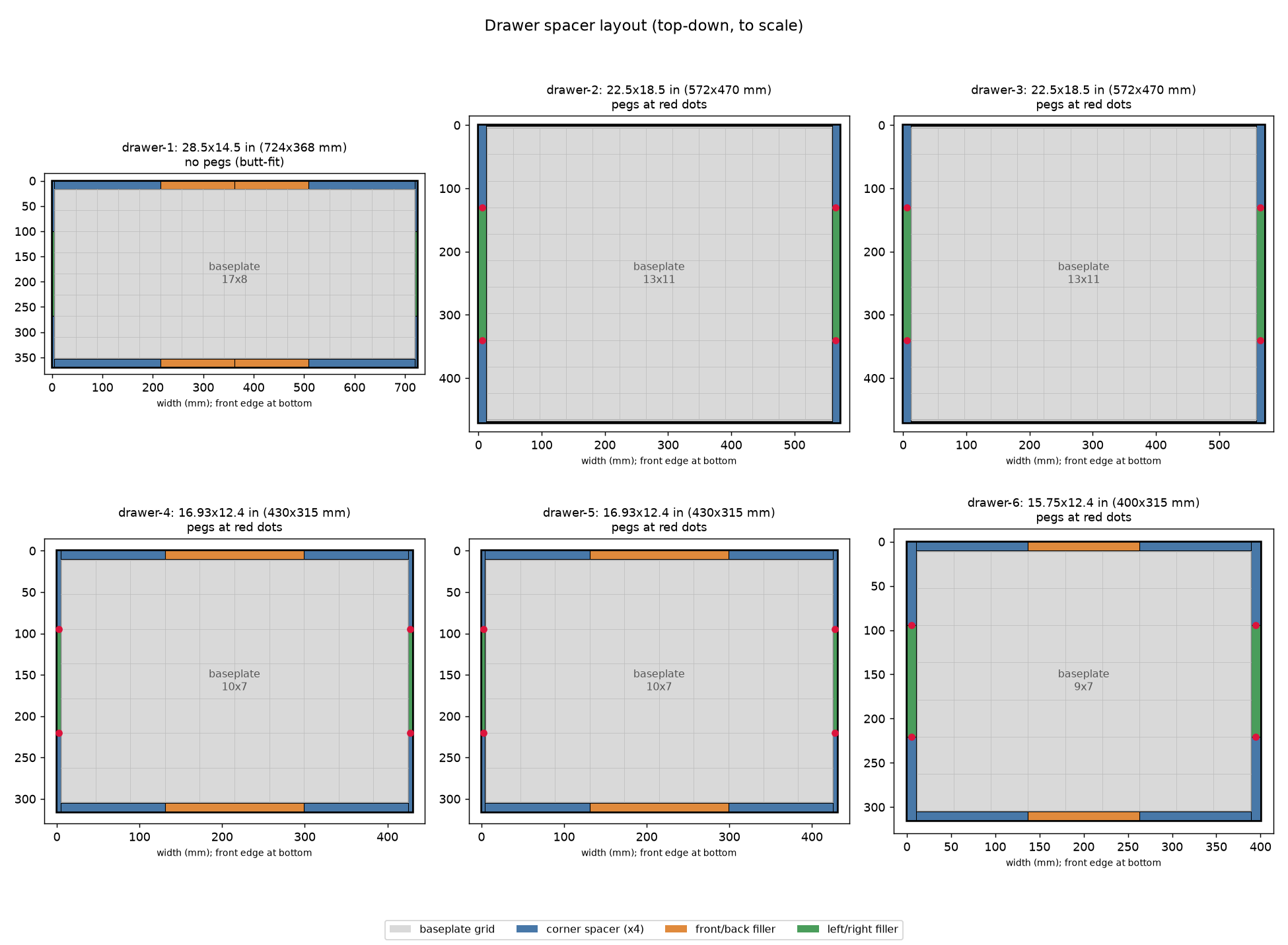
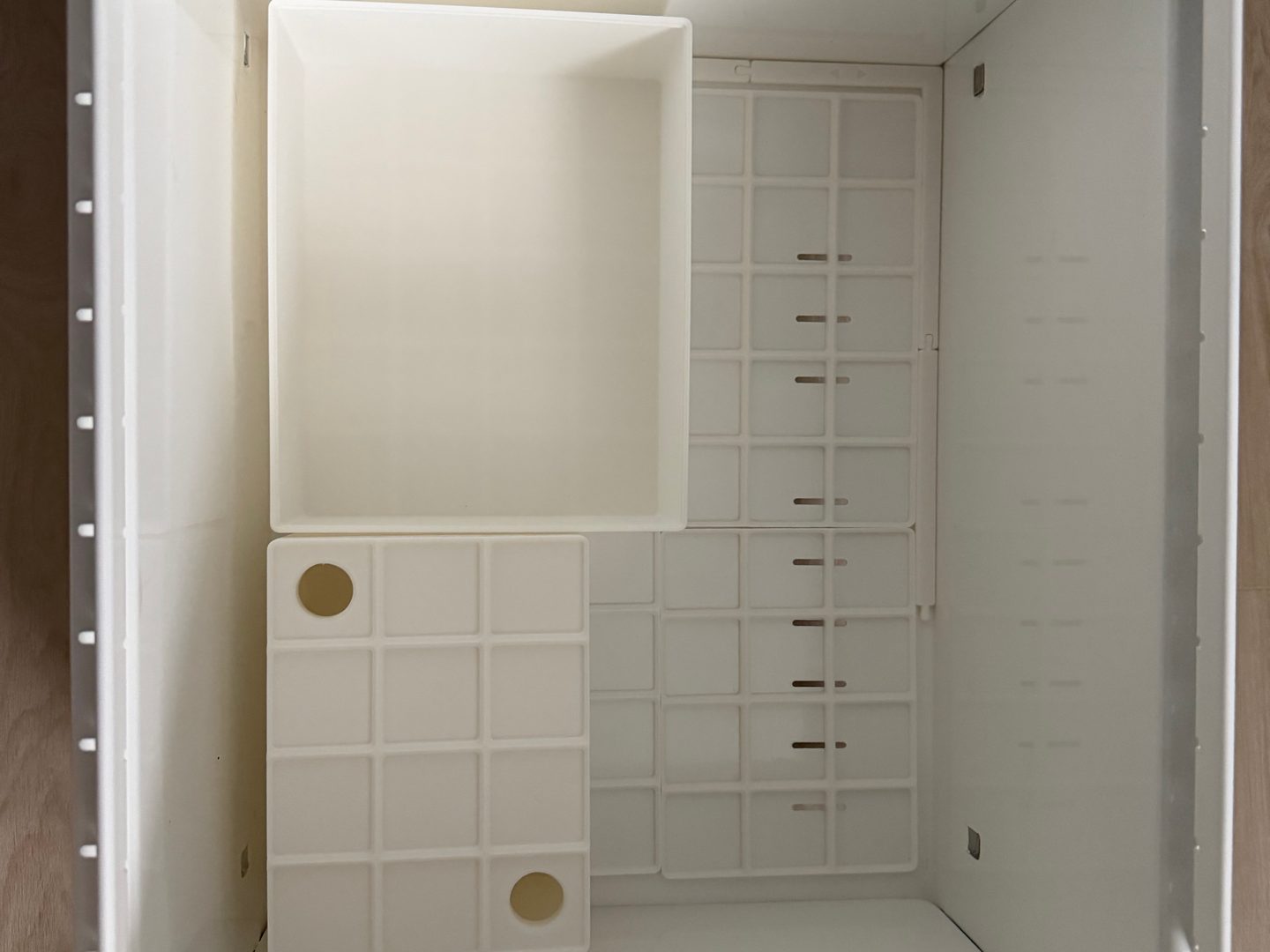
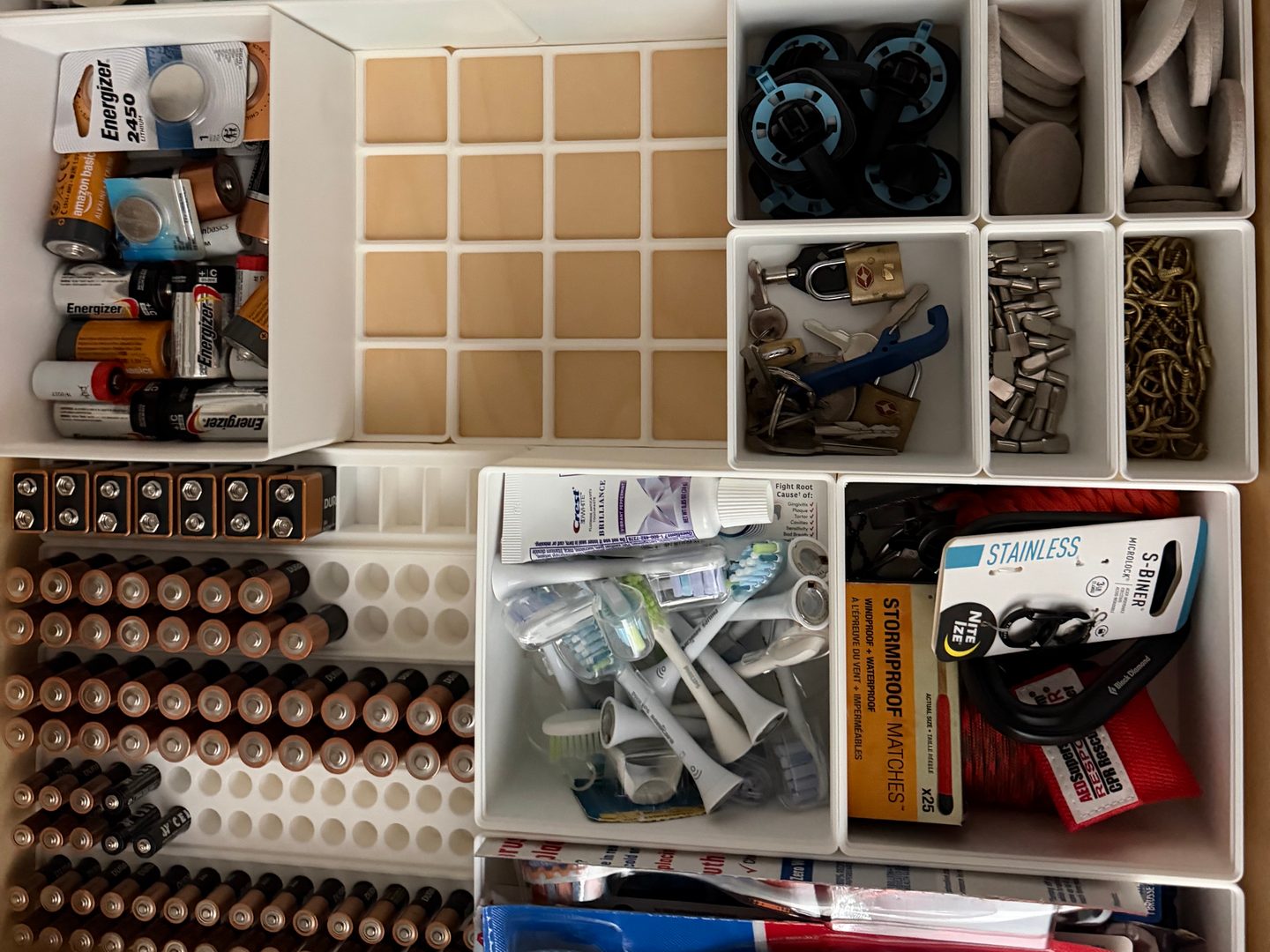
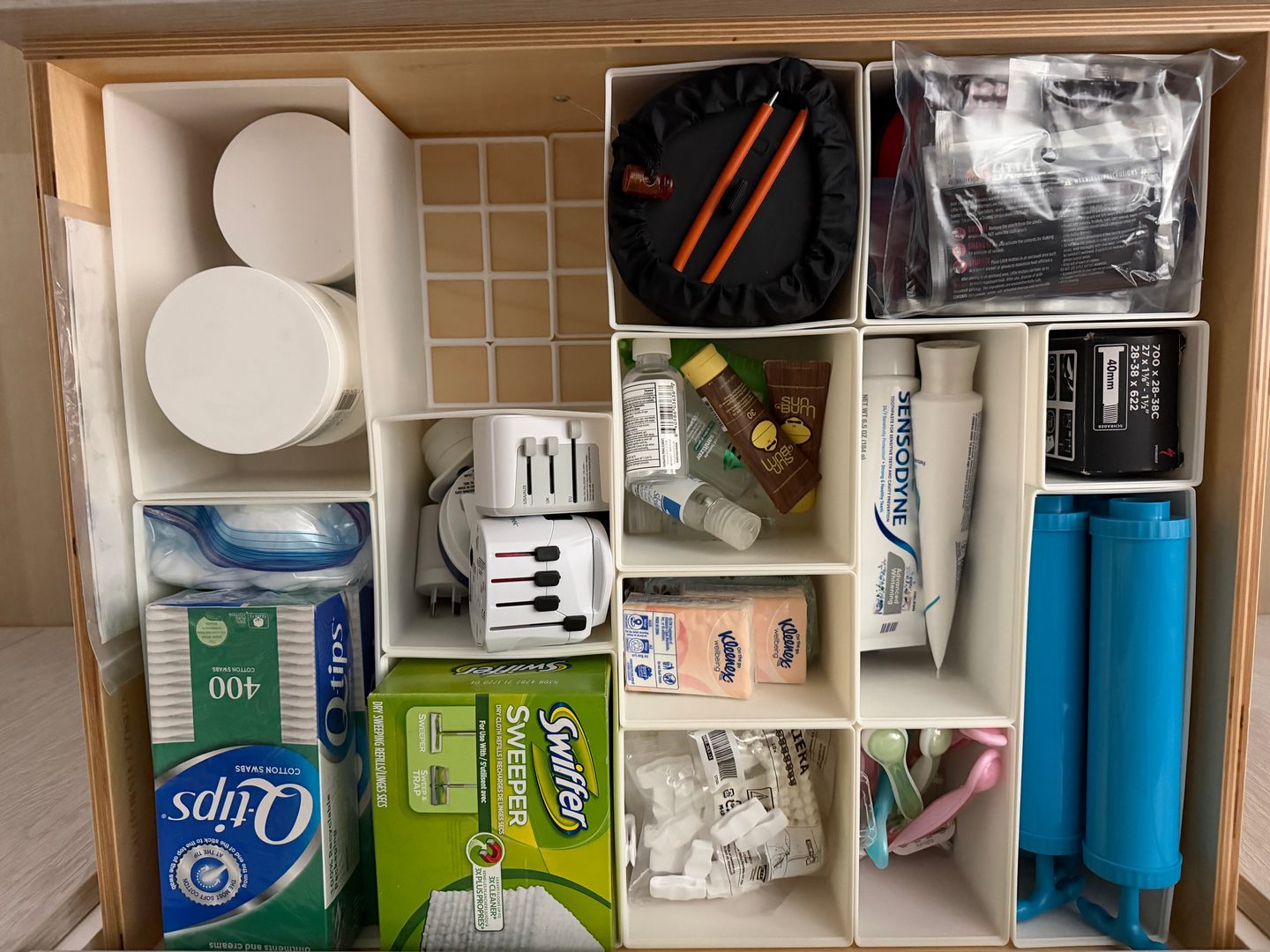
no screenshots — there is no screenThere is no app here to photograph. So this is the plan the script draws of its own output, followed by the parts that came off the printer and the drawers they went into. These are real photographs of real drawers in a real house, which is the point: everything else on this site renders on a screen, and this is the one project you can open.
The crooked drawer
where the whole idea earns its keepDrawer-2 is not square. Its right wall runs about an eighth of an inch shorter than its left — a real piece of furniture, built by people, in a house that has settled. You can measure it as carefully as you like. It stays crooked.
Here is what that costs, in full:
_DRAWER2 = Drawer("drawer-2", 22.5, 18.5, 3.75, length_in_right=18.375) # right wall 1/8" short
That is the fix, entire. length_in_right is a second
measurement taken down the right-hand side, and everything downstream
reads it. The right-hand column does not come out narrower — it comes
out shorter. The script gives that side its own pair of
corner pieces, each trimmed front-to-back, so that between them they
give back exactly the eighth of an inch the wall is missing; the long
filler between them is unchanged, and the column simply ends sooner.
The defect stops being something a person has to remember and becomes
a number that other numbers are derived from. This is the argument for
the whole project in one line — a physical flaw in a piece of
furniture, captured as data, from which a differently-shaped part
falls out automatically.
Drawer-3 is the deeper drawer in the same cabinet. It was never re-measured: the script declares its footprint to be drawer-2's — crooked wall included — and takes a fresh number only for the height. The two drawers accept the same fillers because, seen from above, they are the same hole.
How it's built
boring on purposeThe print bed is 256 mm square, which is smaller than every drawer here. So a baseplate is never one part — the script tiles it, and holds each tile to 210 mm, five grid cells, rather than the six that would technically fit. The last few millimetres of a build plate are where prints go wrong, and there are dozens of tiles: every one of them has to come out right. Individual bins are allowed to break that cap where a single unbroken part is worth it, and four of them run to around 251 mm. Tiles never do.
Changes go through the same pipeline as the rest of the fleet — planned, built, then read by two independent AI reviewers before anything lands. That process is a project in its own right, and it has its own page. This repo differs from its siblings in exactly one way: there is no public copy of it, so the two readers are the only review it gets, and then it merges locally.
What I learned
the printer has opinions and they are correctThe feature that would not print. A Gridfinity bin can carry a label shelf, and mine did — a small tab at the front to take a strip of tape. It is a steep inward overhang, around 50° off vertical, and it prints near the top of a tall part, which is exactly where the part cooling is weakest. On the first print it drooped and frayed. I could have chased it: more cooling, a support structure, a different orientation, an evening of tuning. What I did instead was delete it. The house style now drops the label shelf and the scoop, and the flat top of the lid became the labelling surface — a shallow recess sized for 12 mm tape, printing as a short bridge on the first layer where nothing can sag. A feature that only survives when everything goes right is not a feature, it is a liability. Design for the print you actually get, not the one in the render.
The furniture is wrong, and that is data. My first instinct on the out-of-square drawer was to treat it as a nuisance to be handled at print time — shave a part, pack the gap with a folded card, remember the trick next time. That is knowledge stored in a head, and a head is the worst database available: it is unreadable by anyone else and it fails silently at 11pm, six months from now, when the drawer needs one more bin. Admitting the drawer's real shape into the model cost one argument on one line, and now the crookedness is something the parts are derived from rather than something I have to survive. The best place to put a hard-won fact is in the source, where it can do work.